MDF vs Plywood vs Particleboard: Which Off-Gasses Most in Singapore
4 May 2026 · 5 min read
MDF, plywood, and particleboard release formaldehyde at different rates. The chemistry, E0 to E2 ratings, and what to ask your ID before signing off carpentry in Singapore.
MDF, plywood, and particleboard each release formaldehyde at different rates because they use different amounts and types of adhesive resin. The chemistry matters because Singapore homes are increasingly built with these materials, and the grade specified at the contract stage determines whether your bedroom is at WHO guidance or 5x above it for the first year.
The 60-second answer
All three materials use formaldehyde-based adhesives to bind wood fibres or veneers into structural panels. Particleboard typically uses the most adhesive per cubic metre, plywood the least. But the grade of the resin matters more than the material name: an E0 particleboard emits less than an E2 plywood. In Singapore, where humidity and heat accelerate emission, specifying E0 grade and asking about adhesive chemistry at the ID stage is the single most cost-effective indoor air quality decision you can make.
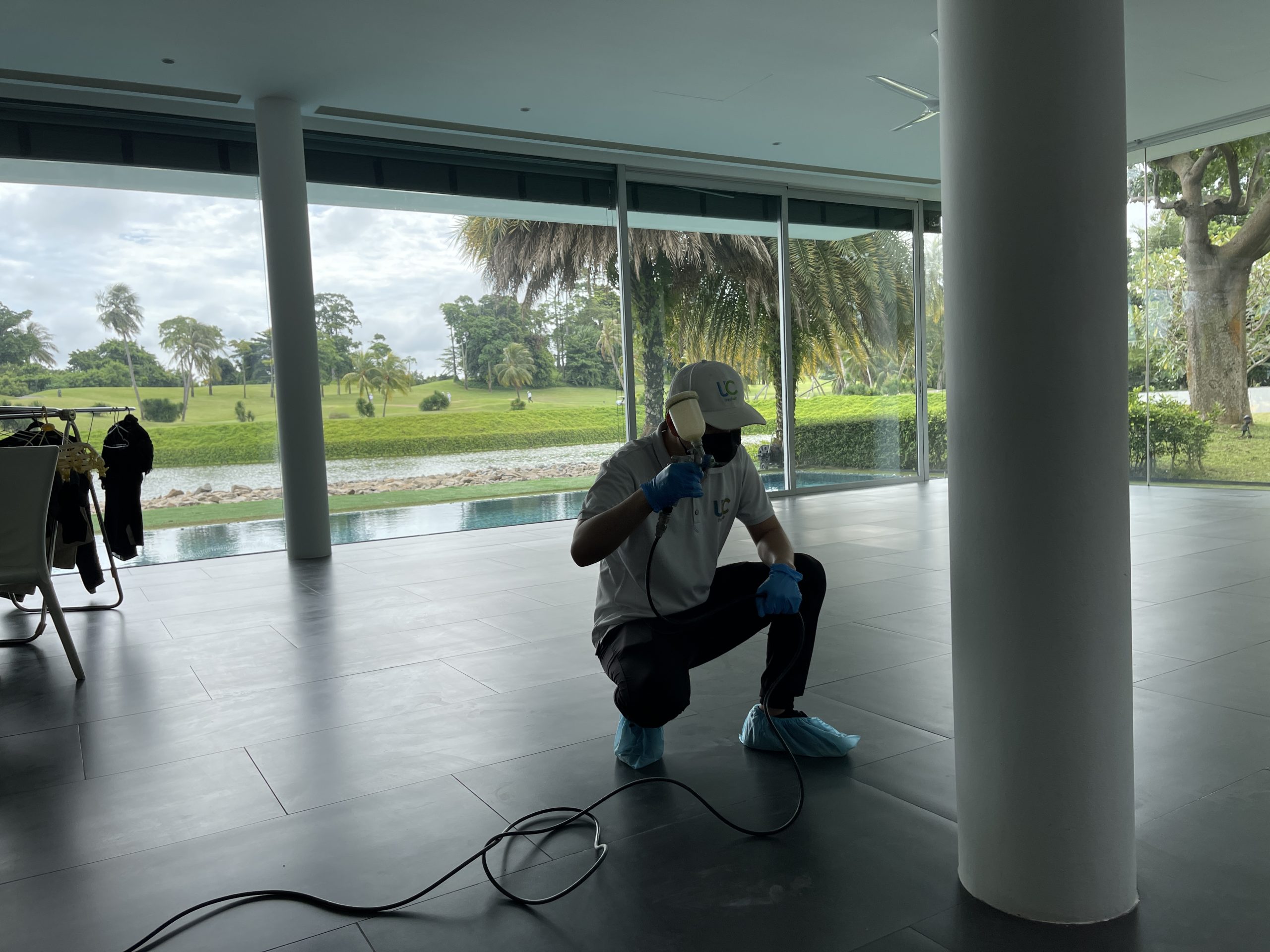
If you are already past that stage and the carpentry is in, source-level treatment can drop emission rates from existing built-ins without rebuild.
How each material is made
The three materials differ in particle size, density, and how much adhesive is needed to hold them together:
- Plywood. Thin sheets of real wood (veneers) are stacked with grain alternating between layers, then bonded with adhesive. Less surface area means less adhesive needed: typical resin content 5 to 8 percent by weight.
- MDF (medium density fibreboard). Wood fibres are pulped, mixed with adhesive, then pressed into smooth dense panels. Higher surface area than plywood means more adhesive: typical resin content 8 to 12 percent.
- Particleboard. Wood chips and shavings (often sawmill waste) are bonded into panels. Most surface area, most adhesive: typical resin content 10 to 14 percent.
More adhesive means more potential formaldehyde emission, all else equal. But the type of adhesive matters more than the absolute quantity.
The adhesive chemistry that actually matters
Three resin types are used in engineered wood, in roughly increasing order of safety:
- Urea-formaldehyde (UF). Cheapest and most common. Releases formaldehyde steadily over years, accelerated by heat and humidity. Standard for cheap MDF and particleboard in Singapore unless higher grade is specified.
- Melamine-urea-formaldehyde (MUF). Adds melamine to slow hydrolysis. Used in HMR (high moisture resistance) boards. Releases formaldehyde at roughly 30 to 50 percent the rate of plain UF.
- Phenol-formaldehyde (PF). Used in marine-grade and exterior plywood. Releases very little formaldehyde once cured, but is more expensive and gives boards a darker colour.
Asking for the resin type explicitly is unusual for residential ID work in Singapore but not unreasonable. PF-bonded plywood, where used, is genuinely lower-emission than any UF or MUF panel.
What E0, E1, E2 actually mean
European emission grades, widely adopted in Asia. The numbers refer to formaldehyde release measured by chamber test or perforator method:
| Grade | Chamber emission (mg/m²/hr) | Perforator (mg per 100g) | Use case |
|---|---|---|---|
| E0 | ≤ 0.07 | ≤ 0.5 | Bedrooms, child rooms, premium spec |
| E1 | ≤ 0.124 | ≤ 8 | Default residential spec in most markets |
| E2 | > 0.124 | > 8 | Industrial, structural, banned in some residential markets |
Two important details:
- None of these are “zero” formaldehyde. They are ceilings, not absences. E0 boards still emit, just at a low rate.
- The total emission of a flat is the sum of all panels. Twenty square metres of E1 board in a small bedroom can produce a higher room-air concentration than ten square metres of E0 in a large open-plan living room. Total exposure scales with both grade and quantity.
In Singapore’s heat and humidity, real-world emissions are typically 1.5 to 2x the lab chamber values. An “E1” cabinet in a 30°C bedroom emits closer to E2 lab levels.
Singapore-specific issues with engineered wood
Three local factors that overseas guides usually miss:
- Climate accelerates breakdown. Urea-formaldehyde resin hydrolyses faster at high humidity. A 70 to 80 percent RH flat ages cabinetry resin faster than a 40 percent RH apartment in Berlin. The high-emission phase is shorter but more intense.
- Imported boards often lack consistent certification. Direct-from-Taobao panels at heavy ID-build discount may be E1, E2, or unrated, depending on supplier and batch. Without a paper trail, assume the worst.
- Cut edges and drilled holes leak more. A laminated MDF panel emits 30 to 60 percent of its formaldehyde through the cut edges, drilled hardware holes, and unsealed back. Most ID-built carpentry leaves these unsealed for cost reasons.
What to specify before signing the carpentry contract
If you are at the planning stage of a renovation, four things to write into the contract:
- E0 grade boards for bedrooms and child rooms. The cost premium over E1 is typically 10 to 20 percent of the carpentry budget, often a few hundred dollars.
- MUF or PF adhesive for kitchen and bathroom built-ins. These rooms see the highest moisture, and standard UF resin breaks down fastest there.
- Sealed edges and drilled holes. Edge banding on all visible edges, and a clear coat or sealer on cut edges that will not be visible (back of carcasses, internal partitions).
- Documentation per batch. Ask for the certification certificate for the actual boards used, not just a brand catalogue claim. Photograph the panel markings before assembly if possible.
These specifications add roughly 15 to 25 percent to the carpentry component of an ID quote and reduce expected indoor formaldehyde levels by 50 to 80 percent.
What if the carpentry is already in?
Most people read this article after the renovation is done and the cabinets are in place. The good news: ripping out is rarely necessary.
Source-level treatment seals the inside of carcasses with a catalyst that converts formaldehyde to water and CO₂ at the surface as it emerges. Treatment of a typical 4-room HDB flat takes one working day. Pre-treatment readings of 0.3 to 0.5 mg/m³ inside cabinets typically drop to under 0.08 mg/m³ within 24 hours, and the catalyst layer keeps working for years.
This is more cost-effective than rebuilding even E1 carpentry in E0, and much faster than waiting 12 to 18 months for unaided fade. Read more on the formaldehyde and TVOC removal page or the HDB and BTO specific guide.
For specific symptoms, see the guides on eyes stinging when opening cabinets and the chemical smell that won’t go away.
Sources
- World Health Organization. Guidelines for Indoor Air Quality: Selected Pollutants. WHO Regional Office for Europe, 2010.
- European Standard EN 13986. Wood-based panels for use in construction. Characteristics, evaluation of conformity and marking.
- U.S. EPA. Formaldehyde Emissions from Composite Wood Products, TSCA Title VI.
- Salthammer, T., Mentese, S., Marutzky, R. Formaldehyde in the Indoor Environment. Chemical Reviews, 2010.
Frequently asked questions
Which is safest: MDF, plywood, or particleboard?
From lowest to highest typical formaldehyde emission: high-grade plywood with E0 phenol-formaldehyde adhesive, MDF rated E0, MDF rated E1, plywood rated E1, particleboard rated E1, particleboard rated E2. The grade matters more than the material name. A well-sealed E0 MDF carcass emits less than an unsealed E1 plywood one. Solid wood is lowest but rarely used for built-ins in Singapore.
What does E0, E1, E2 actually mean?
European emission grades for formaldehyde-releasing wood panels. E0 caps formaldehyde release at 0.07 mg/m² per hour (perforator value 0.5 mg per 100g). E1 is 0.124 mg/m² per hour (perforator 8 mg per 100g). E2 is significantly higher, often banned in residential applications in stricter markets. None of these are 'zero' formaldehyde, they are emission ceilings. In a flat with many square metres of E1 carpentry, the total emission can still exceed WHO room-air guidance.
Is solid wood always better?
For formaldehyde, yes, slightly. Solid wood has no urea-formaldehyde resin. But it warps in Singapore humidity, costs 3 to 5 times more, and uses more old-growth timber. For most cabinetry, well-sealed engineered wood is the practical choice. Where solid wood matters most: bed frames, dining tables, anything close to the breathing zone for hours.
Are HMR and moisture-resistant boards safer?
HMR (high moisture resistance) MDF and similar moisture-resistant particleboard usually use phenol-formaldehyde or melamine-urea-formaldehyde resin instead of plain urea-formaldehyde. These emit substantially less formaldehyde than standard UF board. Specifying HMR for kitchen and bathroom carpentry is a real upgrade and only modestly more expensive.
What should I ask my ID before signing the contract?
Three questions: (1) What is the emission grade of the boards (E0, E1, E2)? Specify in writing. (2) What is the adhesive type for laminating, edge banding, and assembly? Phenol-formaldehyde or PVAc emit far less than urea-formaldehyde. (3) Are cut edges and drilled holes sealed? Sealed edges reduce emission from a single carcass by 30 to 60 percent. Most IDs will not raise these unless you do.
Are imported boards (Taobao, China direct) less safe?
Often yes, but not always. Reputable Chinese manufacturers produce E0 board to spec. The risk is uncertified or wrongly-labelled imports, which are common at the low end of the price range. If your ID sources from Taobao for cost reasons, ask for the certification documentation per batch and check the marking on the panel itself. If documentation cannot be produced, assume E2 emissions and budget for treatment.


Worried About Your Indoor Air Quality?
Get a free site inspection and air quality assessment. We'll show you exactly what's in your air — and how to fix it.