Office Air Quality After a New Fit-Out in Singapore: What to Test, What to Treat
28 April 2026 · 6 min read
New fit-out Singapore offices off-gas formaldehyde and TVOCs for weeks. What staff are smelling, what NEA thresholds to test against, and the right treatment scope.
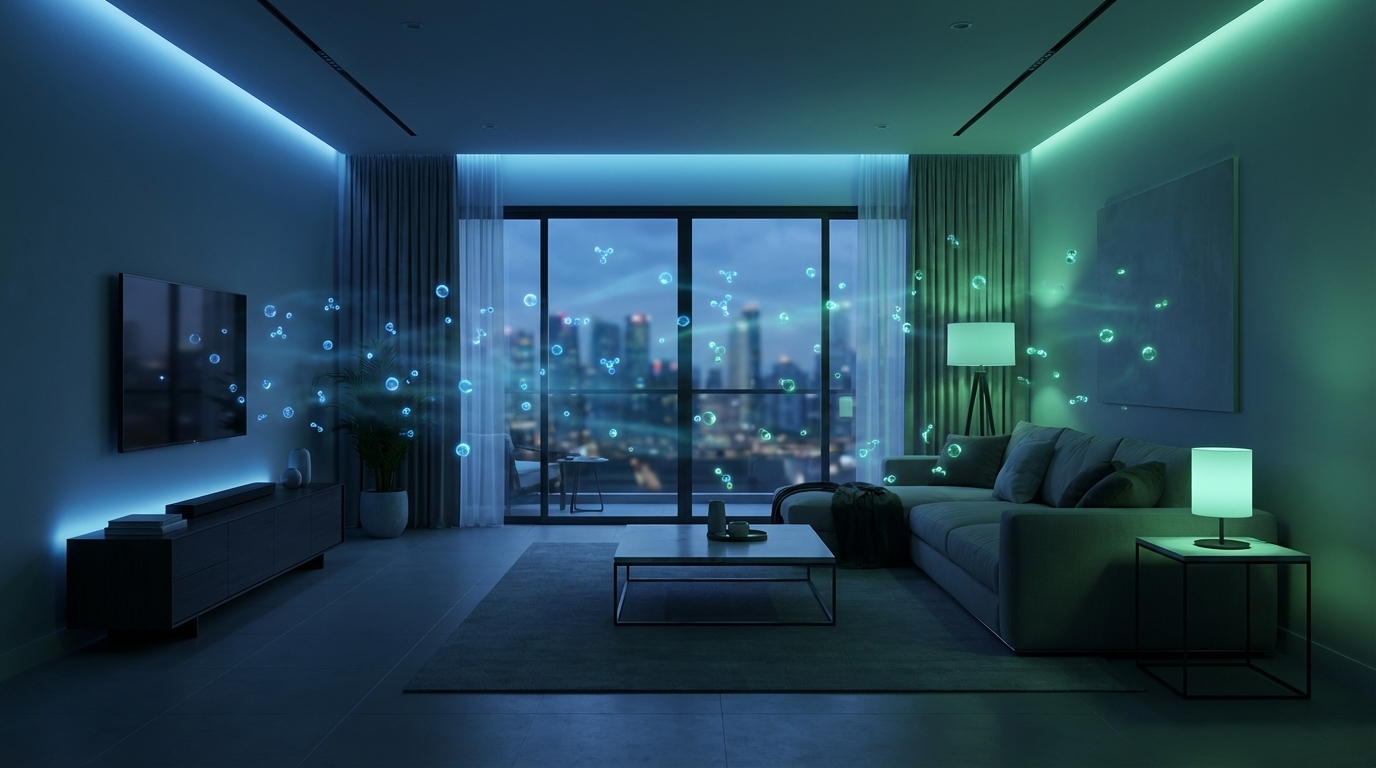
A new fit-out office in Singapore commonly off-gasses formaldehyde and TVOCs at levels above WHO and NEA workplace IAQ thresholds for 6 to 12 months. Staff complaints of headaches, eye irritation, and fatigue after move-in are usually traceable to this. Here is how to test, what readings matter, and what treatment scope actually fixes the source.
The 60-second answer
Post fit-out office air quality in Singapore is shaped by three predictable sources: formaldehyde from MDF carpentry and plywood partitions, TVOCs (benzene, toluene, xylene) from new paint and adhesives, and trapped accumulation from sealed AC environments that recirculate rather than dilute. Test 2 to 4 weeks after fit-out completion against WHO 0.1 mg/m³ for formaldehyde and NEA 0.6 mg/m³ for TVOC. If readings exceed, photocatalytic source treatment of walls, ceilings, carpentry, and HVAC paths is the right intervention; air purifiers are complementary, not substitutes.
Why Singapore office fit-outs off-gas for months
Three reasons:
- MDF and plywood are the dominant formaldehyde source. Reception desks, partitions, storage units, and pantry cabinetry all use medium-density fibreboard or plywood with urea-formaldehyde or melamine-formaldehyde resins. These continue to release HCHO for 6 to 24 months. Singapore’s high humidity (65 to 85 percent indoor) accelerates the release rate.
- Paint and adhesives release BTEX over weeks. Solvent-based paints and water-based latex paints both release benzene, toluene, ethylbenzene, and xylene (the BTEX group) for 4 to 12 weeks post-application. Vinyl flooring adhesives add another month. The smell often peaks in week 2.
- Sealed AC traps the load. CBD office windows do not open. The AC fresh-air intake is often turned down for energy efficiency, so outdoor dilution is limited. The same VOCs recirculate hour after hour. Closed for the weekend, the Monday morning concentration is higher than Friday evening.
This combination means the post fit-out office typically gets worse, not better, in the first 2 to 4 weeks after staff move in.
What staff complaints actually mean
The symptom-to-source mapping in a post fit-out office usually looks like:
- Headaches that resolve when staff leave the office: TVOC exposure, often above 0.6 mg/m³.
- Eye and throat irritation, sneezing, mild burning: formaldehyde exposure, often above 0.1 mg/m³.
- Sweet, sharp chemical smell that does not fade after 4 weeks: confirmed formaldehyde from carpentry, especially under-desk and inside cabinet headspaces.
- Solventy paint smell that persists past week 6: BTEX and other TVOCs from paint or adhesive, may indicate inadequate ventilation during cure.
- Generalised fatigue and reduced concentration: likely combined CO₂ above 1000 ppm and TVOC above NEA threshold, common in over-densified open-plan offices.
If two or more of these patterns are present and they resolve when staff are outside the office, you have a diagnostic-confirmed IAQ issue. Time to test.
What to test against — the NEA thresholds that matter
Singapore office IAQ benchmarks reference WHO Indoor Air Quality Guidelines and NEA workplace IAQ guidance:
- Formaldehyde (HCHO): 0.1 mg/m³ over a 30-minute average. WHO guideline. IARC Group 1 carcinogen.
- Total VOC (TVOC): 0.6 mg/m³. NEA workplace IAQ reference. Sum of benzene, toluene, xylene, and other VOCs.
- PM2.5: 25 µg/m³ over 24 hours. WHO guideline.
- Carbon dioxide: below 1000 ppm during occupied hours. Above 1000 ppm correlates with cognitive decline.
- Humidity: 50 to 70 percent for tropical climates. Below 40 percent dries mucous membranes; above 70 percent feeds microbial growth.
Above any of these, investigate source and treatment. Multiple exceedances at once usually point to a fit-out cause rather than HVAC or occupancy issues.
When to test post fit-out
The optimal testing window is 2 to 4 weeks after carpentry and paint completion. Earlier captures a transient peak as solvents flash off; later may miss the diagnostic window before staff move in.
The conditions for a meaningful test:
- AC running for at least 4 hours before the test, in normal occupied mode.
- Office sealed for at least 8 hours, matching overnight conditions when the load is highest.
- Multiple zones tested, not a single point. Reception, open-plan, meeting rooms, pantry, server room exterior, restrooms.
- Calibrated lab-grade instruments: PID for TVOC, photometric meter for HCHO, optical particle counter for PM2.5.
- 5 to 15 minute readings per zone, with documented peak and average.
A walk-around handheld in five minutes does not produce a usable reading. A proper test produces a written zone-by-zone report against the NEA thresholds.
What treatment actually fixes the source
If the readings exceed thresholds, the question is what to treat with. The options:
- Air purifiers (HEPA + carbon). Filter air passing through them. Once the carbon saturates (3 to 6 months in a high-VOC office), they stop adsorbing and can desorb VOCs back. Useful as a complementary measure but not a fix.
- Photocatalytic source treatment. A water-based, VOC-free coating applied to walls, ceilings, carpentry surfaces, and HVAC return-air paths. Decomposes formaldehyde and TVOCs continuously under ambient light. The active ingredient is titanium dioxide, food-grade rated post-cure.
- Increased fresh-air ventilation. Turning up the AC fresh-air intake. Reduces concentration but does not remove the source; the off-gassing continues, just at lower indoor concentration. Higher energy cost.
- Removal and replacement. Stripping out the off-gassing carpentry. Effective but expensive and disruptive. Usually only feasible for limited high-emission items.
For most Singapore CBD offices, photocatalytic source treatment is the right primary intervention because it addresses the source rather than masking it, has a 1-year effectiveness guarantee, and can be scheduled overnight for zero operational disruption.
What an office IAQ treatment job actually looks like
A typical full-floor treatment for a 2000 sq ft Singapore office:
- Free assessment within 24 to 48 hours of the request.
- Pre-treatment IAQ test zone by zone with calibrated instruments. Documented against NEA thresholds.
- Photocatalytic application overnight, typically 8pm Friday to 8am Saturday. Walls, ceilings, carpentry, HVAC return-air paths.
- Ventilation cycle of 30 to 60 minutes after application.
- Post-treatment verification 2 to 4 weeks later. Second round of calibrated readings.
- Written report including zone-by-zone before/after, products used, batch numbers, MSDS, photos, certificate of completion, 1-year effectiveness guarantee.
The office is safe for re-occupancy within hours. Coating is invisible after curing, non-corrosive on electronics, non-staining on fabric and carpet, food-grade rated post-cure.
Cost expectations
Sample 2026 Singapore market ranges:
- Pre-treatment IAQ test only, mid-size office: S$300 to S$800
- Full treatment with coating, 2000 sq ft post fit-out: S$5,000 to S$12,000
- Per sq ft pricing for larger floors: S$3 to S$8 per sq ft
- Multi-floor corporate accounts: volume discount of 10 to 15 percent
- Add-on antibacterial coating on high-touch surfaces: S$15 to S$30 per surface
The ROI calculation usually pencils out fast against staff productivity loss from chronic headaches, fatigue, and absenteeism in post fit-out offices.
When to escalate beyond IAQ source treatment
A few scenarios where standalone IAQ treatment is not enough:
- Recurring outbreak alongside off-gassing. Pair with deep disinfection and antibacterial coating. See our office disinfection cost guide for pricing.
- Multi-pollutant scenario including water damage history. Add mould remediation scope.
- HVAC fresh-air intake throttled below code. Engage building MCST or facility services to review intake settings.
- Pregnant or chemical-sensitive staff with persistent symptoms. Consider standalone HEPA + carbon air purifiers in their immediate workspace as a complementary measure on top of source treatment.
Sources
- World Health Organization, WHO Guidelines for Indoor Air Quality: Selected Pollutants, 2010.
- Singapore National Environment Agency, Air Quality and Indoor Air Quality Guidance.
- IARC, Formaldehyde: Group 1 carcinogen classification.
- ATSDR, Toxicological Profile for Formaldehyde.
Frequently asked questions
Why does my new fit-out office smell of chemicals?
Post fit-out offices in Singapore typically off-gas formaldehyde from MDF carpentry, plywood partitions, and laminate desks, plus benzene, toluene, and xylene from new paint, vinyl flooring adhesives, and upholstery. Smell intensity peaks in weeks 2 to 4 and tapers over 6 to 12 months. Singapore office air conditioning recirculates rather than dilutes, so smells often get worse, not better, after the office is sealed and occupied.
What are NEA workplace IAQ thresholds for Singapore offices?
NEA workplace IAQ guidance references the WHO 0.1 mg/m³ guideline for formaldehyde over a 30-minute average and 0.6 mg/m³ for total VOCs. Carbon dioxide should be below 1000 ppm and PM2.5 below 25 µg/m³ averaged over 24 hours. Above these levels, employees commonly report headaches, eye irritation, fatigue, and reduced concentration. NEA does not enforce a fine for office IAQ exceedances directly but workplace wellness obligations apply.
When should I test office air quality after a fit-out?
The best timing for post fit-out office IAQ testing is 2 to 4 weeks after the carpentry and paint are completed, with the AC running and the office sealed for at least 8 hours before the test (matching typical occupied-overnight conditions). Earlier than 2 weeks gives a transient peak reading; later than 4 weeks may miss the diagnostic window before staff move in. Re-test 2 to 4 weeks post-treatment to verify reduction.
What does post fit-out office IAQ treatment cost in Singapore?
Post fit-out office IAQ treatment in Singapore is quoted per square foot. Typical ranges: pre-treatment IAQ test S$300 to S$800 standalone, full treatment with photocatalytic coating S$3 to S$8 per sq ft. A 2000 sq ft office post fit-out is usually S$5,000 to S$12,000 inclusive of pre and post-treatment readings, written report, and a 1-year guarantee. Multi-floor and corporate accounts get volume pricing.
How does office IAQ treatment differ from running an air purifier?
An air purifier filters air passing through it. Once the carbon saturates (3 to 6 months in a high-VOC office), it stops adsorbing and can desorb VOCs back into the air. UC Fresh Air photocatalytic coating is applied to walls, ceilings, and HVAC ducts and decomposes formaldehyde and TVOCs at the source 24/7 under ambient light. The two are complementary, not substitutes; for chemical smells from a new fit-out, source treatment is the only permanent fix.
Can office IAQ treatment be scheduled overnight?
Yes, this is the standard for active CBD offices. A full floor coating typically completes overnight (Friday 8pm to Saturday 8am is a common slot) with re-occupancy safe by Monday morning. The coating cures within hours and is food-safe rated post-cure, non-corrosive, non-staining. Disinfection components if booked together need a 30 to 60 minute ventilation cycle before re-entry.
Worried About Your Indoor Air Quality?
Get a free site inspection and air quality assessment. We'll show you exactly what's in your air — and how to fix it.